TAVI (Transcatheter Aortic Valve Implantation), also known as TAVR (Transcatheter Aortic Valve Replacement), is a minimally invasive procedure used to treat severe aortic stenosis, a condition in which the aortic valve becomes narrowed and restricts blood flow from the heart to the body.
For patients looking for a cardiologist in Rohini for advanced heart valve treatment, TAVI offers an important alternative to conventional open-heart valve replacement in appropriately selected patients.
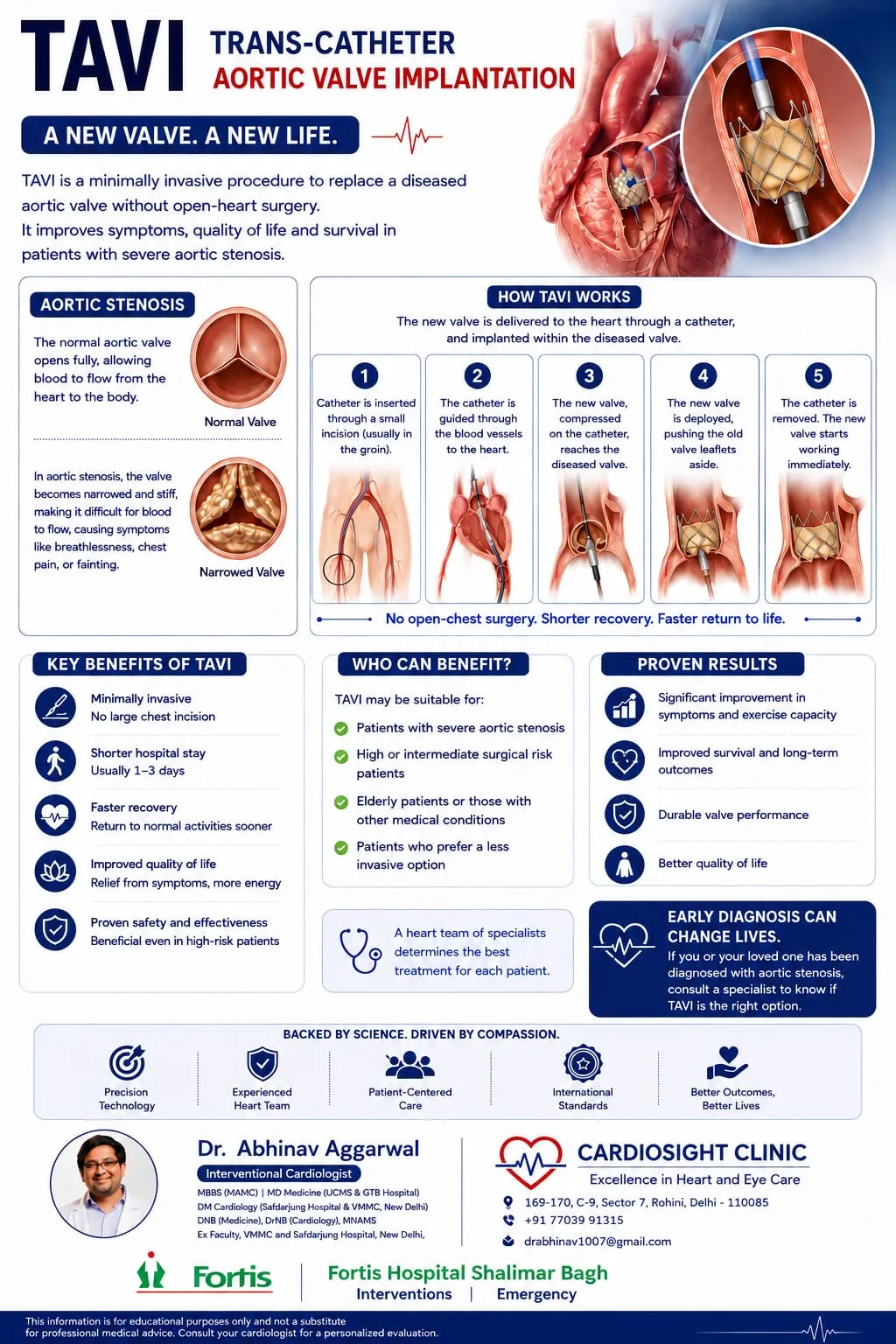
What Is Aortic Stenosis?
The aortic valve allows blood to flow from the heart into the aorta. With age and other risk factors, the valve can become thickened, calcified and progressively narrowed. Severe aortic stenosis can cause breathlessness, chest pain, dizziness, fainting and reduced exercise capacity.
Once severe aortic stenosis becomes symptomatic, timely valve replacement is often recommended because medical treatment alone cannot correct the narrowed valve.
What Is TAVI?
TAVI is a minimally invasive valve replacement procedure in which a new biological valve is delivered through a thin catheter and implanted inside the patient's diseased aortic valve.
Unlike conventional surgical aortic valve replacement, TAVI generally does not require opening the chest or using a heart-lung bypass machine. The new valve pushes the diseased valve leaflets aside and immediately provides a larger opening for blood flow.
The valve is most commonly delivered through the femoral artery in the groin, although alternative access routes may be considered when the femoral arteries are unsuitable.
How TAVI Works
The new valve is delivered to the heart through a catheter and implanted within the diseased valve. In broad terms, the steps are:
- A catheter is inserted through a small incision, usually in the groin.
- The catheter is guided through the blood vessels to the heart.
- The new valve, compressed on the catheter, reaches the diseased valve.
- The new valve is deployed, pushing the old valve leaflets aside.
- The catheter is removed. The new valve starts working immediately.
No open-chest surgery. Shorter recovery. Faster return to normal life.
Who May Benefit From TAVI?
TAVI may be considered for patients with severe aortic stenosis, particularly those who are:
- Symptomatic with severe aortic stenosis
- At increased risk from conventional open-heart surgery
- Older patients who may benefit from a less invasive approach
- Patients with suitable anatomy following detailed evaluation
- Selected patients at lower surgical risk after discussion by a multidisciplinary Heart Team
The choice between TAVI and surgical aortic valve replacement (SAVR) is individualized. Age, life expectancy, valve anatomy, coronary anatomy, surgical risk, vascular access and patient preferences are important considerations.
TAVI Evaluation and Planning
Before TAVI, patients undergo a detailed assessment that may include echocardiography, CT angiography, coronary evaluation, blood tests and clinical assessment. CT imaging is particularly important for determining the size and anatomy of the aortic valve, aortic root and blood vessels used for catheter access.
A multidisciplinary Heart Team evaluates these findings to determine whether TAVI is appropriate and which valve and access route would provide the best outcome.
Benefits of TAVI
TAVI is less invasive than conventional open-heart valve replacement and may offer:
- Smaller access wounds
- Shorter hospital stay in many patients, usually 1–3 days
- Faster recovery and mobilization
- Improvement in breathlessness and exercise capacity
- Rapid restoration of blood flow across the aortic valve
In appropriately selected patients, studies have shown significant improvement in symptoms and exercise capacity, improved survival and long-term outcomes, durable valve performance and better quality of life.
Risks: As with any cardiac procedure, TAVI has potential risks, including bleeding, vascular complications, stroke, infection, kidney injury and the need for a permanent pacemaker in some patients. Careful patient selection and procedural planning are therefore essential.
Advanced Structural Heart Care in Rohini
TAVI requires expertise in structural heart disease, advanced cardiac imaging, vascular access and catheter-based interventions. Patients with severe aortic stenosis should undergo timely evaluation rather than waiting for symptoms to become severe.
Dr. Abhinav Aggarwal, Interventional Cardiologist in Rohini, provides evaluation and advanced interventional treatment for patients with structural heart disease, including TAVI for suitable patients with severe aortic stenosis.
If you are searching for a cardiologist in Rohini for evaluation of aortic stenosis or advanced heart valve treatment, a comprehensive assessment can help determine whether TAVI, surgical valve replacement or another treatment strategy is most appropriate.
Frequently Asked Questions
Is TAVI the same as TAVR?
Yes. TAVI (Transcatheter Aortic Valve Implantation) and TAVR (Transcatheter Aortic Valve Replacement) refer to the same procedure. Both terms are used interchangeably.
Is TAVI open-heart surgery?
No. TAVI is a catheter-based procedure. It generally does not require opening the chest or using a heart-lung bypass machine, which is why recovery is usually faster than after conventional surgical valve replacement.
How long is the hospital stay after TAVI?
Many patients stay in hospital for approximately one to three days, though this depends on the individual clinical situation, the access route used and any complications.
Who decides whether I need TAVI or surgery?
A multidisciplinary Heart Team, typically including an interventional cardiologist, a cardiac surgeon and an imaging specialist, reviews your investigations and clinical profile to determine the most appropriate treatment.
Why is a CT scan needed before TAVI?
CT imaging determines the size and anatomy of the aortic valve and aortic root, and assesses the blood vessels used for catheter access. This information is essential for selecting the correct valve size and the safest access route.
Can aortic stenosis be treated with medicines alone?
No. Medicines may help control symptoms and associated conditions, but they cannot reverse a narrowed aortic valve. Once severe aortic stenosis becomes symptomatic, valve replacement is usually recommended.
The Bottom Line
Early diagnosis and timely valve replacement can significantly improve symptoms, quality of life and outcomes in appropriately selected patients with severe aortic stenosis. If you or a family member has been diagnosed with aortic stenosis, consult a specialist to find out whether TAVI is the right option.
Related reading
About Dr. Abhinav Aggarwal
Dr Abhinav Aggarwal is an Interventional Cardiologist with experience in structural heart disease, advanced cardiac imaging and catheter-based interventions, including TAVI for suitable patients with severe aortic stenosis.
If you have been diagnosed with aortic stenosis or advised valve replacement, a specialist cardiology consultation can help you understand your reports and decide the most appropriate next step.
Book an Appointment arrow_forwardThis article is intended for general patient education and does not replace a professional medical consultation. Please discuss your individual reports and treatment options with your cardiologist.