Angioplasty and stenting, also known as coronary angioplasty or PCI (Percutaneous Coronary Intervention), is a minimally invasive procedure used to open narrowed or blocked coronary arteries and restore blood flow to the heart muscle.
If you are looking for a cardiologist in Rohini for angioplasty and coronary artery disease, it is important to choose an experienced interventional cardiologist who can assess your condition comprehensively and recommend the most appropriate treatment.
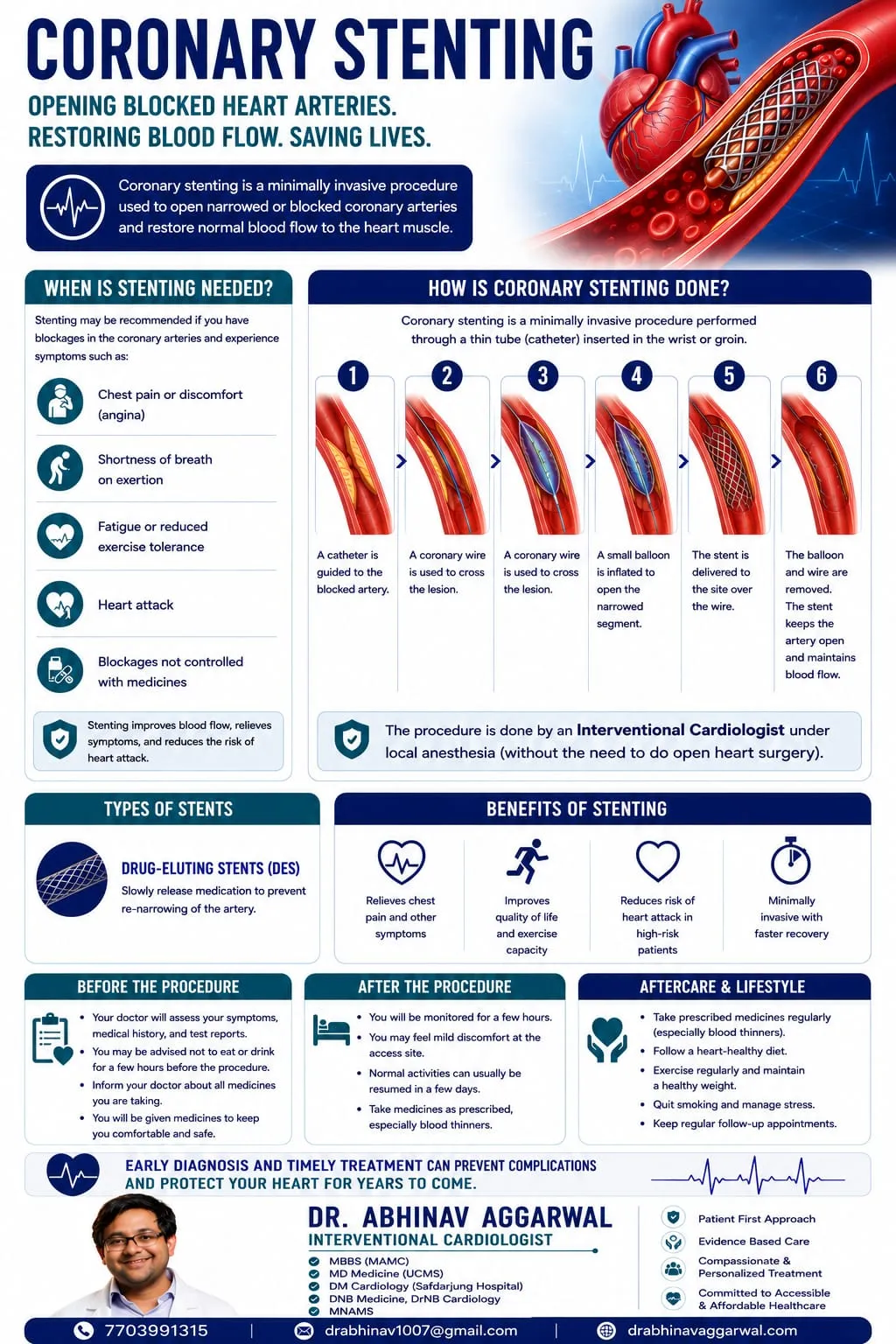
What Is Angioplasty?
Coronary arteries can become narrowed due to the buildup of cholesterol and calcium, a condition known as coronary artery disease (CAD). Reduced blood flow can cause chest pain (angina), breathlessness and, in severe cases, a heart attack.
During angioplasty, a thin catheter is introduced through an artery, commonly through the wrist (radial artery), and guided to the blocked coronary artery. A small balloon is inflated at the narrowed segment to improve the opening of the artery. Usually, a drug-eluting stent is then placed to keep the artery open and maintain blood flow.
How Is Coronary Stenting Done?
Coronary stenting is a minimally invasive procedure performed through a thin tube (catheter) inserted in the wrist or groin, under local anaesthesia, without the need for open heart surgery. In broad terms, the steps are:
- A catheter is guided to the blocked artery.
- A fine coronary wire is used to cross the lesion.
- The wire is advanced beyond the narrowed segment to provide a rail for the equipment.
- A small balloon is inflated to open the narrowed segment.
- The stent is delivered to the site over the wire and deployed.
- The balloon and wire are removed. The stent stays behind to keep the artery open and maintain blood flow.
The procedure is performed by an interventional cardiologist in a cardiac catheterisation laboratory.
When Is Angioplasty Recommended?
Angioplasty may be recommended in patients with:
- Heart attack, particularly STEMI or acute coronary syndrome
- Significant coronary artery blockages causing angina
- Reduced blood flow to the heart demonstrated on appropriate testing
- Symptoms that persist despite optimal medical treatment
- Selected patients with complex coronary artery disease
Symptoms that commonly prompt evaluation include chest pain or discomfort (angina), shortness of breath on exertion, fatigue or reduced exercise tolerance, heart attack, and blockages that are not controlled with medicines.
In patients with stable coronary artery disease, the decision for angioplasty is individualized based on symptoms, coronary anatomy, ischemia and overall cardiovascular risk.
Types of Stents
Drug-eluting stents (DES) slowly release medication to reduce the chance of the artery re-narrowing at the treated segment. These are the most commonly used stents in contemporary practice.
The choice of stent, its diameter and its length are decided by the interventional cardiologist based on the anatomy of the artery being treated.
Benefits of Stenting
- Relieves chest pain and other symptoms
- Improves quality of life and exercise capacity
- Reduces the risk of heart attack in high-risk patients
- Minimally invasive with faster recovery than open surgery
Advanced and Complex Angioplasty
Modern interventional cardiology has made it possible to treat many patients with complex coronary blockages. Depending on the anatomy, specialized techniques may be used for calcified arteries, chronic total occlusions (CTO), bifurcation lesions, left main coronary artery disease and other challenging blockages.
Intravascular imaging such as IVUS and OCT, along with physiological assessment such as FFR and iFR, can help interventional cardiologists understand the artery more accurately and optimize stent placement.
Angioplasty After a Heart Attack
In a heart attack caused by a sudden blockage of a coronary artery, primary angioplasty (primary PCI) is an important emergency treatment. Rapid restoration of blood flow can limit damage to the heart muscle and improve outcomes.
Important: Patients with symptoms suggestive of a heart attack should seek emergency medical attention immediately.
Before, After and Long-Term Care
Before the procedure
- Your doctor will assess your symptoms, medical history and test reports.
- You may be advised not to eat or drink for a few hours beforehand.
- Inform your doctor about all medicines you are taking.
- You will be given medicines to keep you comfortable and safe.
After the procedure
- You will be monitored for a few hours.
- You may feel mild discomfort at the access site.
- Normal activities can usually be resumed in a few days.
- Take medicines as prescribed, especially blood thinners.
Aftercare & lifestyle
- Take prescribed medicines regularly, especially blood thinners.
- Follow a heart-healthy diet.
- Exercise regularly and maintain a healthy weight.
- Quit smoking and manage stress.
- Keep regular follow-up appointments.
Choosing the Right Cardiologist
The success of angioplasty depends not only on the stent but also on appropriate patient selection, understanding of coronary anatomy, procedural expertise and careful follow-up. An experienced interventional cardiologist can evaluate the patient's symptoms and investigations and discuss whether angioplasty, bypass surgery or medical treatment is most appropriate.
Dr. Abhinav Aggarwal is an experienced Interventional Cardiologist in Rohini, Delhi, providing comprehensive treatment for coronary artery disease, including coronary angioplasty, stenting, primary PCI and complex coronary interventions. Patients seeking a cardiologist in Rohini for evaluation of chest pain, coronary blockages or angioplasty can undergo a detailed assessment and receive an individualized treatment plan.
Frequently Asked Questions
Is angioplasty a major surgery?
No. Angioplasty is a minimally invasive catheter-based procedure performed under local anaesthesia. The chest is not opened and a heart-lung bypass machine is not required.
Is angioplasty painful?
The access site at the wrist or groin is numbed with local anaesthetic. Patients may feel pressure during catheter insertion, but significant pain is not expected during the procedure.
How long does recovery after stenting take?
Patients are usually monitored for a few hours after the procedure, and normal activities can generally be resumed within a few days. The exact timeline depends on the clinical situation, the access site used and whether the procedure was performed electively or during a heart attack.
Does every blockage need a stent?
No. Angioplasty is not required for every patient with a coronary blockage. The appropriate treatment depends on the severity and location of the blockage, symptoms, heart function, associated medical conditions and overall cardiovascular risk. Many patients are managed with medicines and risk factor control.
How long do I need to take blood thinners after a stent?
Antiplatelet medication after stenting is essential and the duration is decided individually by your cardiologist based on the type of stent, the reason for the procedure and your bleeding risk. These medicines should never be stopped without consulting your cardiologist.
Angioplasty or bypass surgery — which is better?
Neither is universally better. The decision depends on the number and pattern of blocked arteries, left main involvement, diabetes, heart function, other medical conditions and patient preference. Your cardiologist and, where appropriate, a heart team will discuss the most suitable option for you.
The Bottom Line
Angioplasty and stenting can relieve symptoms, improve quality of life and, in the right patients, reduce the risk of a heart attack. Early diagnosis and timely treatment can prevent complications and protect your heart for years to come.
Important: Angioplasty is not required for every patient with a coronary blockage. The appropriate treatment depends on the severity and location of the blockage, symptoms, heart function, associated medical conditions and overall cardiovascular risk.
Related reading
About Dr. Abhinav Aggarwal
Dr Abhinav Aggarwal is an Interventional Cardiologist with experience in the evaluation and management of coronary artery disease, complex coronary interventions and angioplasty.
If you have been advised coronary angiography, angioplasty or stenting, a specialist cardiology consultation can help you understand your reports and decide the most appropriate next step.
Book an Appointment arrow_forwardThis article is intended for general patient education and does not replace a professional medical consultation. Please discuss your individual reports and treatment options with your cardiologist.