If you have chest pain or are suspected to have coronary artery disease, your cardiologist may recommend a test to look for blockages in the arteries supplying your heart.
Two commonly discussed tests are:
- CT Coronary Angiography (CTCA) — a non-invasive scan of the coronary arteries
- Invasive Coronary Angiography (ICA) — a catheter-based procedure that directly visualizes the coronary arteries
Although both can show coronary artery blockages, they are not the same test and are used for different clinical situations.
The choice between CT coronary angiography and invasive coronary angiography depends on your symptoms, risk factors, previous test results, kidney function, heart rate, calcium burden and the likelihood that treatment may be required.
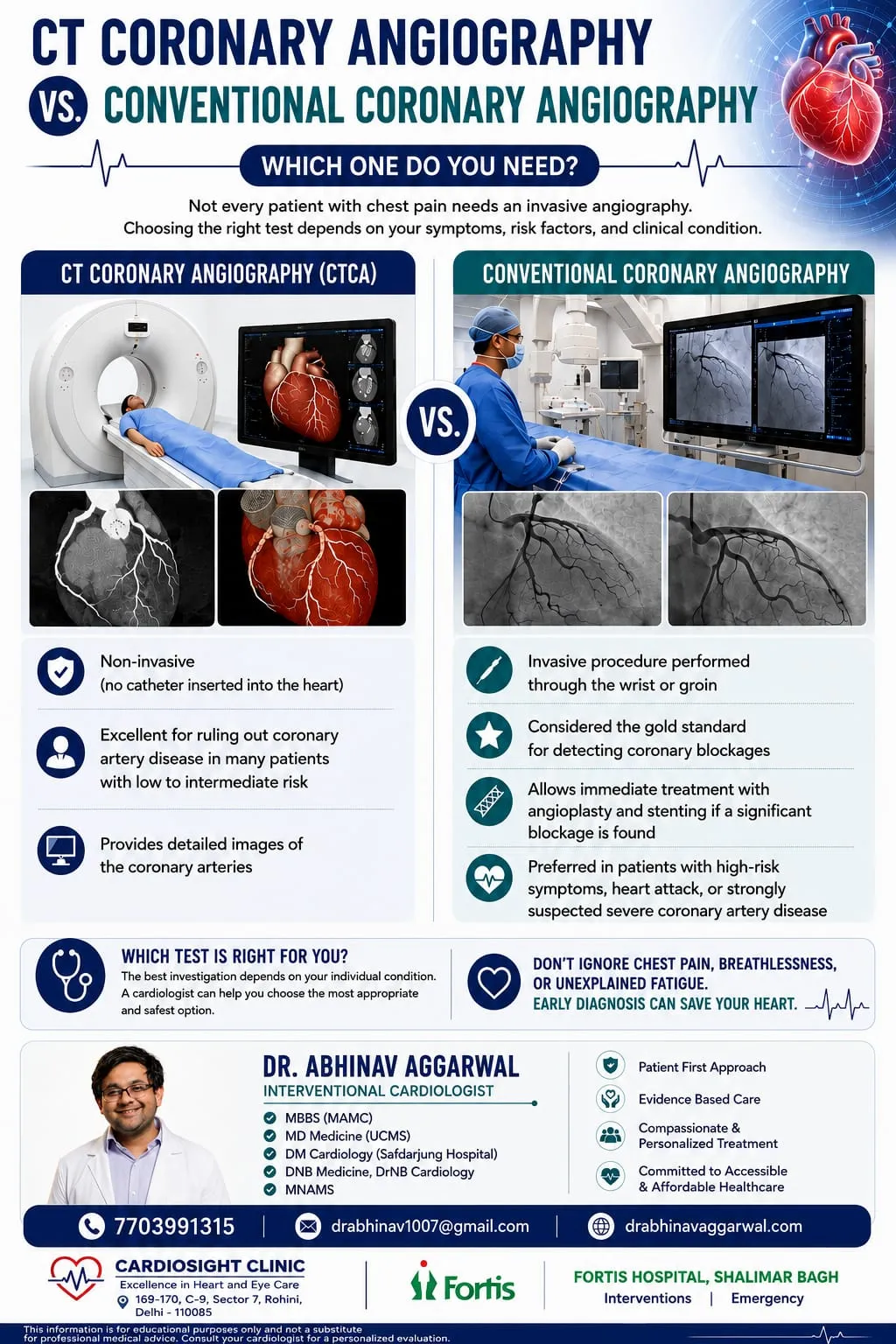
What Is CT Coronary Angiography?
CT coronary angiography, also called CT coronary angiogram or coronary CT angiography, is a non-invasive imaging test used to examine the coronary arteries.
A small intravenous cannula is placed in a vein, usually in the arm. Contrast dye is injected through the vein while a CT scanner takes detailed images of the heart and coronary arteries.
CTCA can show:
- Coronary artery narrowing
- Cholesterol plaques
- Calcified plaques
- Non-calcified plaques
- The location and extent of coronary artery disease
- The overall anatomy of the coronary arteries
Importantly, no catheter is inserted into the coronary arteries during CT coronary angiography.
What Is Invasive Coronary Angiography?
Invasive coronary angiography, commonly called a coronary angiogram, is an established procedure used to directly visualize the coronary arteries.
A thin catheter is introduced through an artery, most commonly through the wrist (radial artery) and sometimes through the groin (femoral artery).
The catheter is guided towards the heart and contrast is injected directly into the coronary arteries while X-ray images are obtained.
One major advantage of invasive coronary angiography is that it can be followed immediately by treatment when appropriate.
If a significant blockage is identified, the cardiologist may be able to perform:
- Balloon angioplasty
- Coronary stenting
- Other complex coronary interventions
Therefore, invasive coronary angiography can be both diagnostic and therapeutic.
CT Coronary Angiography vs Invasive Coronary Angiography
| Feature | CT Coronary Angiography | Invasive Coronary Angiography |
|---|---|---|
| Type of test | Non-invasive imaging | Invasive catheter procedure |
| Catheter inserted into artery | No | Yes |
| Contrast | Through an IV | Directly into coronary arteries |
| X-rays used | Yes | Yes |
| Shows coronary blockages | Yes | Yes |
| Shows coronary plaque | Excellent | Primarily shows lumen narrowing |
| Can assess calcium | Yes | Limited compared with CT |
| Can perform angioplasty | No | Yes |
| Can place a stent | No | Yes |
| Recovery | Usually very quick | Requires post-procedure observation |
| Major role | Diagnosis | Diagnosis + treatment |
| Best suited for | Many patients with suspected CAD | Higher-risk patients or those likely to require intervention |
Which Test Is More Accurate?
This is a common question: "Is CT coronary angiography as accurate as invasive angiography?"
Modern CT coronary angiography provides excellent anatomical information and is particularly useful for ruling out significant obstructive coronary artery disease in appropriately selected patients.
However, the two tests provide somewhat different types of information.
CTCA provides high-resolution anatomical images of the coronary arteries and the plaque within their walls.
Invasive angiography directly images the contrast-filled coronary artery lumen and remains the reference invasive test when an intervention may be required.
Importantly, a narrowing seen on either test does not automatically mean that a stent is required.
The cardiologist may need additional information about whether a particular blockage is actually reducing blood flow to the heart.
Advantages of CT Coronary Angiography
1. It is non-invasive
There is no catheter inserted into the coronary arteries.
2. It is useful for ruling out coronary artery disease
A normal, high-quality CT coronary angiogram can provide strong reassurance in appropriately selected patients.
3. It shows plaque
CT can demonstrate both calcified and non-calcified coronary plaque, providing information beyond simply looking at the lumen.
4. It provides detailed coronary anatomy
CTCA can help identify the location and extent of coronary artery disease and coronary artery anatomy.
5. Recovery is quick
Because there is no arterial catheterization, patients can generally return to their usual activities quickly, depending on the circumstances.
Limitations of CT Coronary Angiography
CTCA is an excellent test, but it is not suitable for everyone.
Image quality can be affected by:
- Very high heart rate
- Irregular heart rhythm
- Extensive coronary artery calcium
- Certain coronary stents
- Previous bypass surgery
- Inability to hold the breath
- Severe obesity or other technical factors
CTCA also requires iodinated contrast and involves radiation exposure.
Most importantly, CTCA cannot treat a blockage.
If a significant lesion is found and intervention is considered necessary, invasive coronary angiography may subsequently be required.
Advantages of Invasive Coronary Angiography
1. Direct visualization of the coronary arteries
Contrast is injected directly into the coronary arteries, allowing detailed assessment of the coronary lumen.
2. Treatment can be performed during the same procedure
If a suitable significant blockage is identified, angioplasty and stenting can often be performed during the same session.
3. Useful in high-risk situations
Invasive angiography is particularly important when there is a high likelihood of significant coronary disease or when urgent treatment may be required.
4. Important in heart attacks
In patients with certain types of acute coronary syndrome, urgent invasive coronary angiography may be required because treatment such as angioplasty can be performed without waiting for a separate diagnostic procedure.
Limitations and Risks of Invasive Coronary Angiography
Because invasive angiography involves arterial catheterization, it carries procedural risks.
These can include:
- Bruising or bleeding at the catheter insertion site
- Contrast reactions
- Kidney-related complications in susceptible patients
- Blood vessel complications
- Rarely, more serious cardiovascular complications
The overall risk is generally low when the procedure is performed for an appropriate indication by an experienced team, but the risks and benefits should always be discussed with your cardiologist.
CT Coronary Angiography or Invasive Angiography: Which One Should I Have?
There is no single test that is best for every patient.
CT coronary angiography may be considered when:
- Coronary artery disease is suspected
- The probability of significant disease is not very high
- A non-invasive anatomical assessment is appropriate
- Previous cardiac testing has been inconclusive
- The patient is clinically stable
Invasive coronary angiography may be preferred when:
- There is a high likelihood of significant coronary artery disease
- Symptoms strongly suggest obstructive coronary disease
- Non-invasive tests suggest significant ischemia
- The patient has certain high-risk findings
- A coronary intervention may be required
- The patient is experiencing an acute coronary syndrome requiring an invasive strategy
The decision should be made by your cardiologist after considering the complete clinical picture.
Can CT Coronary Angiography Replace Invasive Angiography?
Not always.
CT coronary angiography has significantly reduced the need for diagnostic invasive angiography in appropriately selected patients.
However, invasive angiography remains essential when:
- A coronary blockage is likely to require treatment
- The patient has high-risk coronary disease
- Urgent intervention is required
- CT images are inconclusive
- Coronary anatomy is too complex to be adequately assessed by CT
In simple terms:
CTCA answers: "Do I have coronary artery disease and what does my coronary anatomy look like?"
Invasive angiography answers: "What do my coronary arteries look like, and can we treat a significant blockage now?"
Does a Blockage on CT Mean I Need Angioplasty?
No.
This is one of the most important misconceptions about heart blockages.
A blockage identified on CT coronary angiography does not automatically mean that you need a stent.
Your cardiologist may consider:
- Your symptoms
- The severity and location of the narrowing
- Plaque characteristics
- Heart function
- Exercise or stress-test findings
- Evidence of reduced blood flow
- Overall coronary anatomy
- Other medical conditions
In selected cases, additional physiological assessment such as FFR or iFR during invasive angiography can help determine whether a blockage is functionally significant.
CT Coronary Angiography vs Angiography: A Simple Example
Imagine the coronary arteries as roads carrying traffic to different parts of a city.
CT coronary angiography is like taking a highly detailed aerial map of the roads.
It can show where the roads are narrowed and where there is plaque.
Invasive coronary angiography is like sending a vehicle directly onto the road and examining the narrowing from inside the road system.
And if a major obstruction is found, the cardiologist can potentially open the road during the same procedure using angioplasty and a stent.
This is why the two tests complement each other rather than simply competing with one another.
Frequently Asked Questions
Is CT coronary angiography painful?
Usually, CTCA is not painful. Contrast is administered through an IV cannula, and the CT scan itself is brief.
Is invasive coronary angiography painful?
The catheter insertion site is usually numbed with local anaesthetic. Patients may feel pressure during catheter insertion but significant pain is not expected.
Which is safer: CTCA or invasive angiography?
CTCA avoids arterial catheterization and therefore avoids many catheter-related risks. However, both procedures have their own risks and should be selected based on the clinical situation.
Which test is better for detecting heart blockage?
Both can detect coronary artery narrowing, but they are used differently. CTCA is an excellent non-invasive diagnostic test in appropriately selected patients, while invasive angiography is particularly important when detailed invasive assessment or treatment may be required.
Can angioplasty be done after CT coronary angiography?
Yes. If CTCA identifies potentially significant disease, your cardiologist may recommend invasive coronary angiography. If an appropriate blockage is confirmed, angioplasty and stenting may be performed.
Is CT coronary angiography the same as a CT scan of the heart?
CT coronary angiography is a specialized cardiac CT examination specifically designed to visualize the coronary arteries.
The Bottom Line
CT coronary angiography and invasive coronary angiography are complementary tests, not competing tests.
CTCA is a non-invasive way to look for coronary artery disease, while invasive coronary angiography provides direct visualization of the coronary arteries and allows angioplasty and stenting when required.
The right test depends on your symptoms, cardiovascular risk, previous investigations and the likelihood that treatment may be needed.
If you have been advised a CT coronary angiogram or coronary angiography, discuss the reason for the test with your cardiologist. The goal is not simply to find a blockage—it is to determine whether that blockage matters and what treatment, if any, will benefit you.
Related reading
About Dr. Abhinav Aggarwal
Dr Abhinav Aggarwal is an Interventional Cardiologist with experience in the evaluation and management of coronary artery disease, complex coronary interventions and angioplasty.
If you have been advised CT coronary angiography, coronary angiography or angioplasty, a specialist cardiology consultation can help you understand your reports and decide the most appropriate next step.
Book an Appointment arrow_forwardThis article is intended for general patient education and does not replace a professional medical consultation. Please discuss your individual reports and treatment options with your cardiologist.